A Director Prepares
Designed as a commercial teaching tool, Mackendrick began work on A Director Prepares, “a series of six one-hour instructional video-tapes concerning Film-making,” in the mid-1980s. Mackendrick wasn’t the author of accompanying promotional document, though the ideas it contains are his and it uses extracts from his handouts written for film students at the California Institute of the Arts, where he taught from 1969 until his death in 1993. But A Director Prepares does nonetheless give a good summary of Mackendrick’s reasons why such an audio-visual project was important to him, as well as offering insight into why he chose never to edit his many years worth of notes into a book. As he is quoted on page 1: “It has become obvious to me after twenty years as a film-educator that the only way to teach film is with film. It is simply not possible to discuss film satisfactorily in a literary or verbal medium. The language of the medium can only be appreciated in its own medium: the moving picture with sound.”
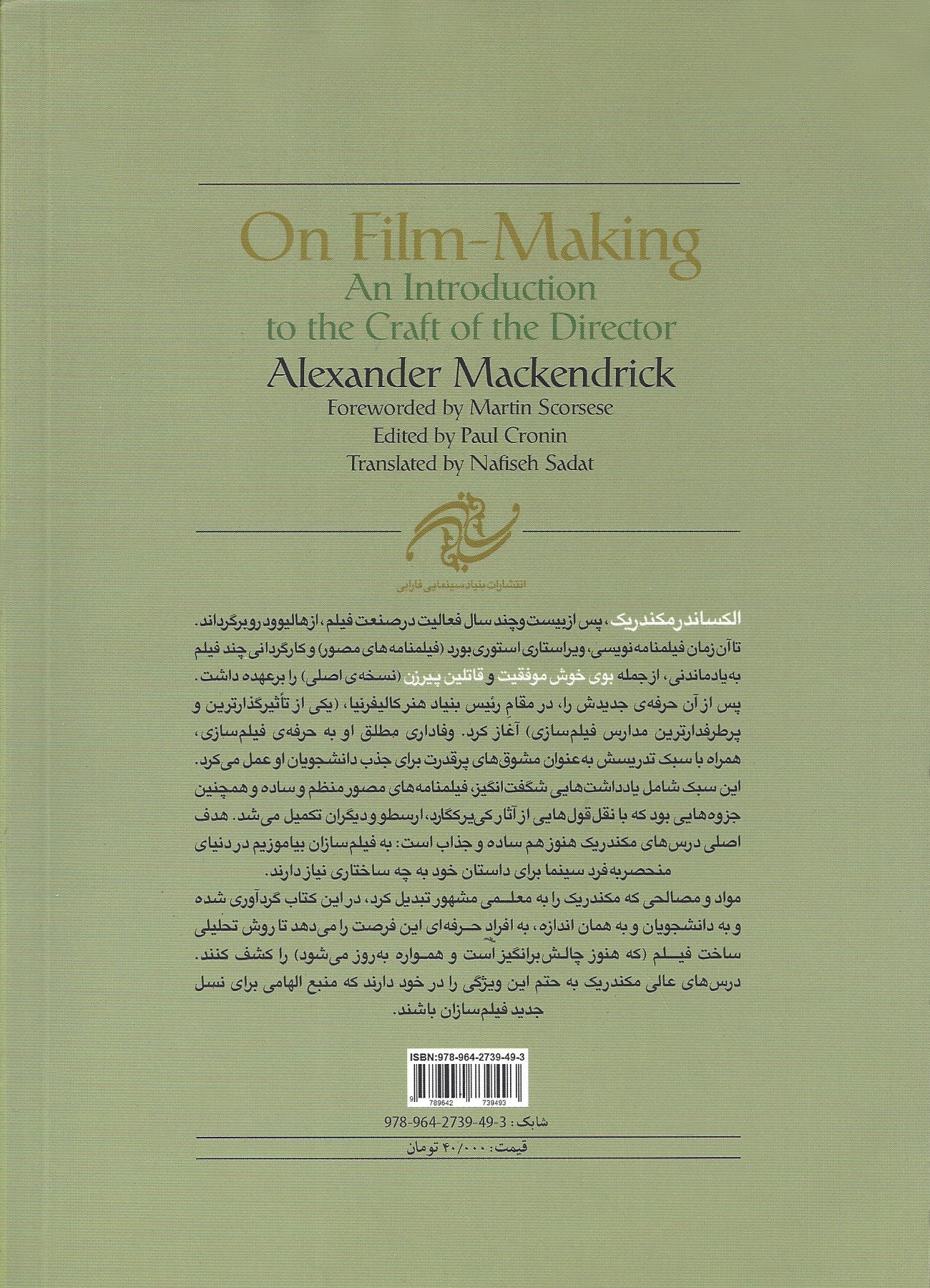
Much material was shot in the studios and on the campus of CalArts for A Director Prepares, but the project was never completed, and only a short section was ever edited together. One reason why Mackendrick abandoned the project was that he felt it lacked coherence as an educational exercise. He knew that what he hoped the material would impart to students was better learned actively “on the job.” As such, we needn’t feel overly disappointed with the fact that A Director Prepares doesn’t exist in the form Mackendrick had originally conceived (every substantive issue discussed in this document turns up, in one form or another, in Mackendrick’s book On Film-Making: An Introduction to the Craft of the Director). While the idea of Mackendrick talking with Alec Guinness and Douglas Slocombe (his director of photography on The Man in the White Suit and other films) about the craft of cinema is mouth-watering (see page 2), no such conversations were ever filmed. Material that was to make up the “two handbooks to accompany the series” (page 3) and the essay “A Technique for Having Ideas” (page 10) can be found in Mackendrick’s book.
A Director Prepares had two key starting points. One was theatre director Peter Brook’s 1968 book
The Empty Space, in which Brook writes about an exercise he and his actors developed involving the transformation of several lines from Romeo and Juliet into dialogue that could be played “in a realistic situation,” using “words that they could use unselfconsciously in a film.” The other was Mackendrick’s belief (page 2) that “One of the best places for the director to learn his craft is, surprisingly, in the editing room.” This was an idea to be explored through the use of (page 1) “unedited footage from the film” that Mackendrick planned to make, and that would show him putting into practice his theoretical ideas. Such a film was, indeed, filmed at CalArts, using students as actors, in the mid-1980s. The Terrorists (strictly speaking Mackendrick’s final film) tells the story of a group attempting to stop a bomb from being exploded on campus. While a finished version of this short exists (described on page 2 as “a simple chase film”), its real value was as an editing exercise. Confronted with a written script and a multitude of shots, students would attempt to piece the narrative together in the editing room.
As former student John Sorensen explains, “This is purely hypothetical on my part since I didn’t cut the piece together, but it would not surprise me if he booby-trapped some things. If he was trying to make us learn how badly we needed full coverage, it wouldn’t amaze me if he didn’t shoot full coverage on one or two scenes so we could curse him and ask, ‘Why did you not give me the shot I need?’” Another student, Dan Selakovich, picks up the story: “So I edited it, and I thought, ‘This doesn’t work that well. I’m editing a Sandy Mackendrick film. What am I doing wrong?’ I went to Sandy and said, ‘I edited the film you made for the directing class.’ He said, ‘What do you think?’ I said, ‘To be honest I think it’s missing some shots. We could use some…’ And he said, ‘Close-ups?’ and pulled a reel of close-ups from his desk that he’d purposely held back from students, so they could discover on their own what was missing. Later I realized, when I became a professional editor, that directors didn’t have missing shots sitting on the shelf like Sandy did. They just didn’t exist.” Student work on The Terrorists was identical to the well-known exercise devised years before by ACE, in which raw unedited footage of various shots that make up a scene from the popular American television show Gunsmoke was supplied to film schools. A vast number of cutting opportunities (for example a slow, ponderous version versus a fast, quick-edited variation, or one that emphasizes one character’s point of view over another) is possible with such material.
And in case you’re wondering, the “nasty old limerick” Mackendrick talks about on page 16 of the promotional document (also mentioned in sections four and five of the educational audio/visual project that accompanies On Film-Making) goes as follows:
There was a young hooker from Khartoum
Who took a nancy boy up to her room.
They stayed up all night, debating the right,
Of who should do what with which and to whom.
Here is a version of A Director Prepares, edited from as much existing footage as could be located. It’s a flawed piece, technically not entirely up to scratch, but does allow us to see Mackendrick in action, working with actors, blocking a scene and sketching shots. Here for a version of the post-production script and other details.
© Mackendrick Family Trust